

The tailor's craft, the secrets of exceptional know-how
We all have a suit in our wardrobe, whether it's a skirt or trouser suit. Indeed, it's a wardrobe essential. However, tailoring is a complex garment that requires real expertise. We take you with us to Portugal, to the family-owned factory where our suits have been made for over three years, to discover the secrets of how they are made.
WHAT IS THE "TAILOR'S WAY"?
The term used to describe a tailor's skills and craftsmanship is "façon", and those who master the art are known as "façonniers".

UNIQUE KNOW-HOW
It takes several hours to make a suit. This highly technical garment requires specific machinery that only certain workshops possess (piping, collar and belt machines, heat presses...). What's more, blazers and pants are complex pieces to work with. The slightest flaw is immediately apparent, especially on plain fabrics, as no pattern distracts attention. Falling, seams, fit... everything must be impeccable!
The finest suits and tailors come from factories and workshops specializing in this garment. Even today, it is impossible to automate the production of a quality suit. Cutting, assembly and finishing are all stages that require human dexterity and control.

DISCOVERING THE TAILOR'S WAY 17:10
Our factory is located in the Fundao textile region of Portugal, on the Spanish border. It's a family-run factory employing 250 people. You won't find jeans, t-shirts or knitwear here. We chose this factory, which specializes in tailoring, for its traditional know-how, which enables us to offer you high-quality tailoring. It has become a benchmark in the design of men's and women's suits, and works for major brands such as Hugo Boss, Max Mara, Tommy Hilfiger and Burton.
When it comes to fabrics, the materials we use to make our suits are carefully selected. We work with Italian Super 100S wool, a top-quality wool sheet renowned for its softness and comfort.

HOW IS A SUIT MADE?
Whether you prefer a slim-fitting, fit or oversized jacket, they all follow the same manufacturing process.
The manufacture of a suit involves a huge number of stages and a colossal amount of work. The jacket is also more labor-intensive than a pair of pants, as it involves a greater number of operations. What's more, you'd never suspect the complexity of a tailor's jacket, since many of the steps are "invisible".
It takes about 120 steps to make a jacket and 40 for a pair of pants. Each operation lasts one minute, so it takes two hours to make a jacket and 40 minutes for a pair of pants. In the workshop, each technician carries out 2 operations.

STEPS IN THE TAILOR'S PRODUCTION PROCESS
There are 8 main stages in making a suit:
- Pattern processing
- Fabric preparation
- fit
- Labeling
- Thermobonding
- Assembly
- Ironing
- Quality control
1. PATTERN PROCESSING
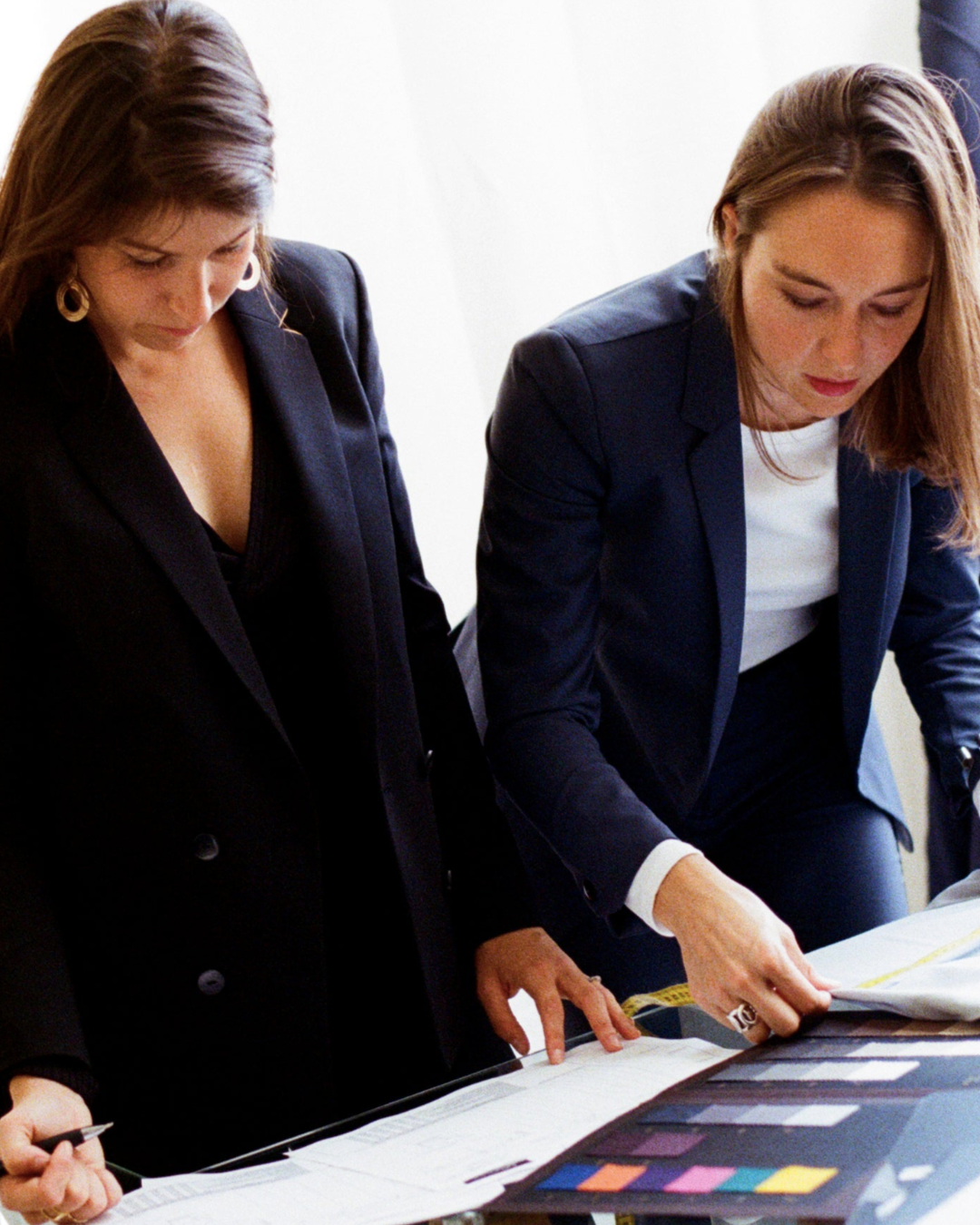
The tailoring process begins on the computer. We send our patterns to the factory, which creates the fit plan, taking care to optimize fabric use as much as possible to avoid waste.
2. FABRIC PREPARATION
The fabric is then prepared for fit.
For stripes or checks, you need a special machine that adapts to the pattern to ensure a perfect fit. Making a patterned suit is therefore even more meticulous than making a plain one.

3. fit
The machine then uses the pattern to cut the fabric and lining.
The factory we work with is committed to an eco-responsible, 0-waste approach. Wool offcuts are recycled for reuse, thus avoiding waste. Pieces of fabric are unraveled and then reused as padding for mattresses or seats, for example.
4. LABELLING
Once the different pieces of the tailor are cut, they are all labeled so that they don't get mixed up during the rest of the process. They can then be easily assembled.
Each roll of fabric has its own sequence, so that there is no color discrepancy between the different pieces of a suit, however small.
5. THERMOCOLLAGE
On jackets and pants, certain parts are heat-bonded for extra hold. The pieces are then put through a 140° machine for 30 seconds.
For this step, each person takes care of a different part of the garment: the front, the sleeves, the collar...

6. ASSEMBLY
Next comes assembly, the stage with the most operations. There is a precise order to follow when training the tailor.
For a jacket, we start with the sleeves, and as with every part of the garment, there are a number of operations to perform.
First, iron the lower sleeve and open the seam, then add the buttonholes. Then sew the lining, leaving a small opening for the rest of the process.
The chest darts are then sewn on. Then the various body parts of the jacket are assembled together: the front with the bib, the pockets, the collar with our 17:10 notch, the epaulettes... Each worker is responsible for one part of the assembly.
Finally, the label 17:10 is added.

7. REASSAGE
The jacket is perfectly assembled, all that remains is to iron it into shape.
The next step is to shape the jacket using an ironing system.
8. QUALITY CONTROL
Throughout the manufacturing process, several checks are carried out to ensure that the product meets quality criteria. The manufacturing process ends with quality control before the product is dispatched.
Now you know all the secrets of tailoring. An outfit that can be worn without moderation and adapted to any occasion!